
New York is not only skyscrapers and yellow taxis. It is also rivers — wide, busy, powerful rivers. And above these rivers rise bridges. They look calm and strong, but each one has a dramatic story. Some were once world records. Some changed how people lived. Every day, millions cross them.
Let us look closer at seven of the most iconic bridges in New York City.
#1 Queensboro Bridge (59th Street Bridge)
Queensboro bridge stretches from Manhattan to Queens. It has a powerful steel truss system and its main cantilever span measures 1,182 feet. Many movies and songs have made it part of popular culture, such as:
- Spider-Man (2002)
- The Dark Knight Rises (2012)
- Manhattan (1979)
- I Am Legend (2007)
- Cloverfield (2008)
- “The 59th Street Bridge Song (Feelin’ Groovy)” – Simon & Garfunkel (1966) – Perhaps the most famous reference.
- Also, NYC rappers often reference the Queensboro Bridge as a symbol of traveling between boroughs, life in Queens, or connecting to Manhattan.
#2 Williamsburg Bridge
The Williamsburg Bridge opened in 1903. At completion, its 1,600-foot main span made it the longest suspension bridge in the world. The total length reaches about 7,308 feet.
Built mainly of steel, the bridge has a raw, practical beauty. It was created to serve working neighborhoods filled with immigrants seeking new lives in America. Every day, thousands crossed it to reach factories.
Time was not always kind to the structure. Rust and heavy use required major repairs late in the 20th century.
#3 Brooklyn Bridge
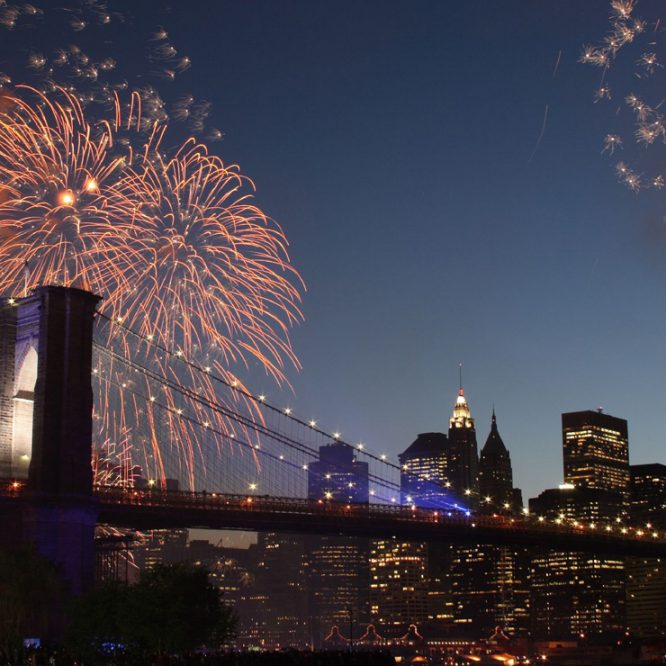
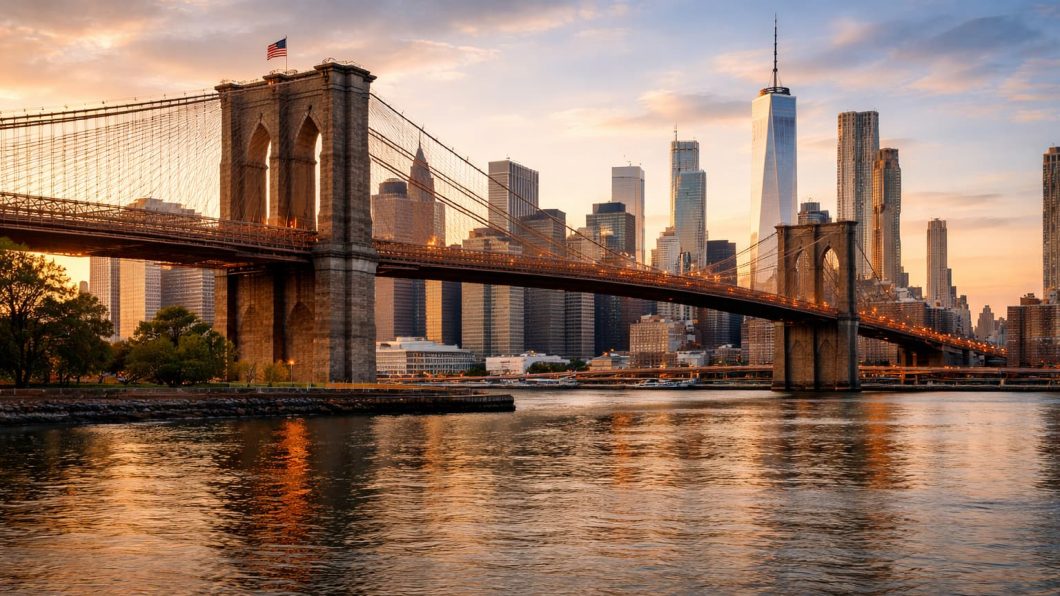
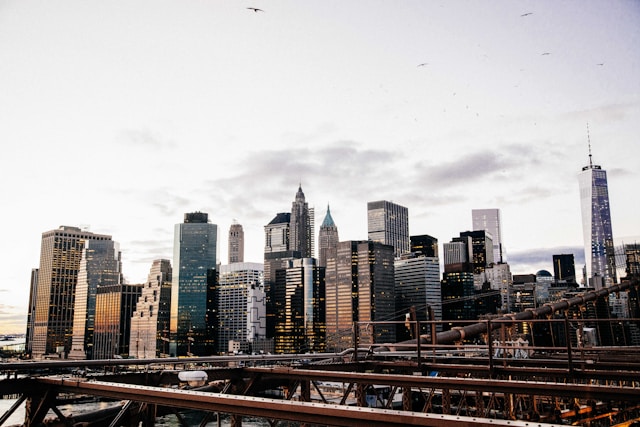
When the Brooklyn Bridge opened in 1883, people called it a wonder of the modern world. Its main span stretches 1,595 feet, and the full length is about 6,016 feet. At that time, it was the longest suspension bridge ever built.
The bridge was designed by engineer John A. Roebling and completed by his son Washington Roebling. Massive stone towers rise 276 feet above the East River. Thick steel cables hold the roadway high in the air. Using steel in this way was revolutionary in the 19th century.
Construction was difficult. More than 20 workers lost their lives.
#4 Manhattan Bridge
Opened in 1909, the Manhattan Bridge stretches 6,855 feet (2,089 metres) across the East River, with a main suspension span of 1,470 feet (448 metres). Designed by engineer Leon Moisseiff, it was among the first suspension bridges to use modern deflection theory — an innovative approach that allowed the structure to be lighter and more flexible than earlier designs. Built of steel, its two open-frame towers rise high above the river, carrying four massive cables that support the roadway and subway tracks below.
What makes it especially distinctive is its layered movement. Unlike the nearby Brooklyn Bridge, it carries four subway lines in addition to cars, cyclists and pedestrians. The constant vibration of trains shaped both its engineering challenges and its long history of repairs and reinforcement. On the Manhattan side, a grand Beaux-Arts arch and colonnade, inspired by European triumphal gates, frame the entrance — a reminder that infrastructure was once designed as civic art.
To many, it is iconic not because it is the oldest or the largest, but because it feels alive. Trains rumble across it. Traffic flows endlessly. From its pedestrian path, the view of the Brooklyn Bridge framed between steel cables is one of the most photographed perspectives in New York.

#5 Bronx–Whitestone Bridge
Opened in 1939, the Bronx–Whitestone Bridge links Queens and the Bronx. Its main span measures 2,300 feet, with a total length of about 3,770 feet.
The bridge has elegant, slender steel towers. Soon after opening, engineers noticed that strong winds caused too much movement. Reinforcements were added to stabilize the structure.
Built during the rise of the automobile age, the bridge helped shape suburban growth and modern traffic patterns in New York City.
#6 Verrazzano-Narrows Bridge
The Verrazzano-Narrows Bridge opened in 1964. With a main span of 4,260 feet and a total length of about 13,700 feet, it was the longest suspension bridge in the world at the time.
Its two towers rise 693 feet above the water at the entrance to New York Harbor. Because of the Earth’s curvature, the tops of the towers are slightly farther apart than their bases.
This massive steel bridge connects Brooklyn and Staten Island. It carries only vehicles and has two traffic levels. Every year, thousands of runners begin the New York City Marathon here.
#7 George Washington Bridge
When the George Washington Bridge opened in 1931, it was one of the longest suspension bridges on Earth. Its main span reaches 3,500 feet. Two enormous steel towers rise 604 feet above the Hudson River.
The bridge connects Manhattan with New Jersey. It quickly became one of the most important transport links in the United States. Today, it carries more vehicle traffic than any other bridge in the world. Its towers were meant to be covered in stone, but the design was left in exposed steel.
These seven bridges represent bold ideas, technical progress and the spirit of a city that never stops building upward and outward.